
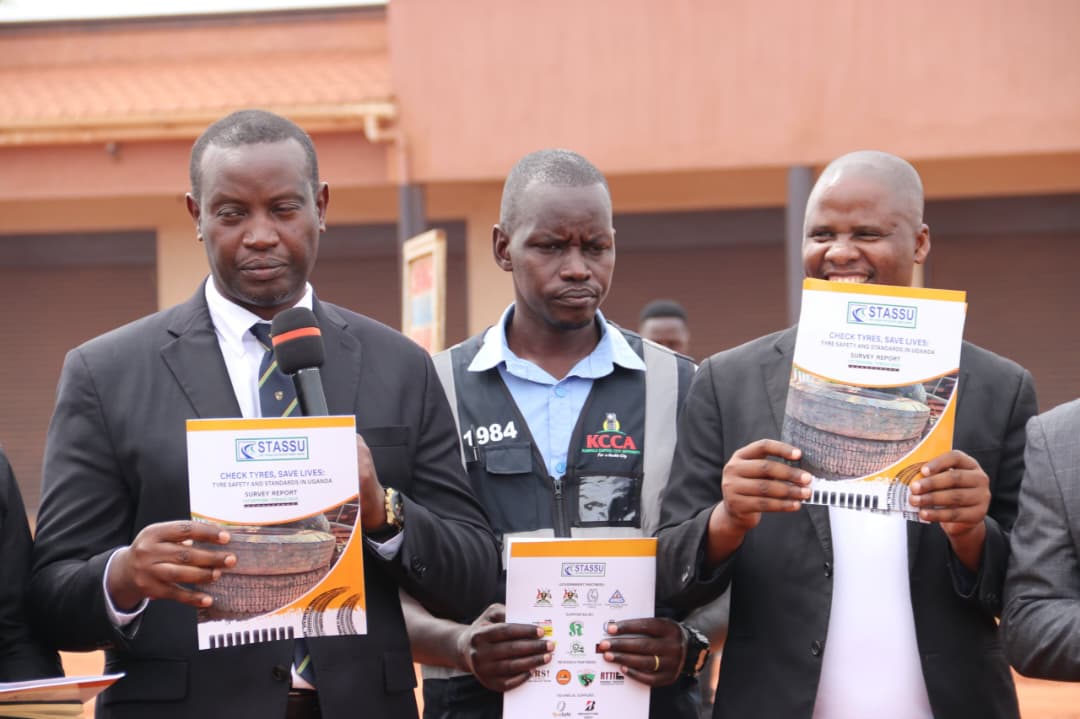
Road safety stakeholders have called for tougher enforcement of tyre safety standards and the introduction of new regulations after a survey found that nearly half of Ugandan road users lack basic knowledge of tyre safety, raising concerns over vehicle roadworthiness and road crash prevention.
The call follows the launch of the inaugural Tyre Safety and Standards Quarterly Report at Bwaise Transport Terminal in Kampala on Thursday by the Standards and Transport Safety Association (STASA) and its partners, including TyreSafe UK, Bridgestone India, Legacy Road Safety Initiative, Tyre Express, Kampala Logistics Centre, Road Transport Training Institute (RTTI), Uganda National Transport Alliance and other transport sector stakeholders.
According to the report, 48 percent of respondents had no meaningful knowledge of tyre safety, while only 31 percent demonstrated comprehensive knowledge. A further 21 percent had limited or partial awareness.
The survey, whose respondents were predominantly commercial boda boda riders, also found that although 94 percent claimed they inspect their tyres daily, the responses were inconsistent with their actual knowledge and maintenance practices.
Researchers said this suggests that many road users conduct only superficial visual inspections instead of properly assessing tyre condition.
The report further revealed that only two percent of respondents correctly identified the legal minimum tyre tread depth, while 71 percent could not, highlighting widespread ignorance of tyre safety regulations.
It also found a significant mismatch between confidence and competence, with 80 percent of respondents expressing confidence in checking their tyres despite 41 percent admitting they could not read tyre specifications such as size, load index, speed rating and manufacturing date.
On tyre maintenance, 66 percent of respondents said they replace worn-out tyres with new ones, while 22 percent rely on repairing punctures instead of replacing damaged tyres. Another 10 percent purchase second-hand tyres and three percent continue using tyres until they are completely worn out.
The report attributes these practices to financial constraints, limited awareness and inadequate access to quality tyres.
Although 80 percent of respondents reported checking their tyres weekly, only nine percent own tyre pressure gauges, with many relying on petrol stations or visual inspection alone.
The survey also found strong public support for roadside tyre inspections. While 75 percent of respondents supported increased roadside tyre checks, only 19 percent said they had ever received a penalty or had their vehicle grounded because of tyre-related defects, suggesting enforcement remains inconsistent.
Speaking at the launch, Assistant Commissioner for Road Transport Regulation and Safety at the Ministry of Works and Transport, Apollo Kashanku, described road crashes as one of Uganda's biggest public safety challenges.
"We don't know who the next victim of road accidents will be," Kashanku said.
He noted that an average of 14 people die on Uganda's roads every day, most of them in their productive years, and urged motorists to pay as much attention to their tyres as they do to other parts of their vehicles.
"The only contact your vehicle has with the road is the tyre. We spend a lot of time washing our vehicles but pay very little attention to the tyres," he said.
Kashanku warned that fake and substandard tyres remain common on the Ugandan market, saying many motorists unknowingly purchase products whose quality and origin cannot easily be verified.
"You go into a shop and find tyres with names you don't even know where they come from. Most of the time these tyres don't serve you well. Why not buy a quality tyre that will serve you and also keep you safe?" he said.
He said government would develop regulations to promote proper tyre use as part of wider efforts to improve road safety.
"We will put in place regulations on the proper use of tyres so that going forward we can reduce this very dangerous scourge," Kashanku said.
James Akena, a consultant with the Legacy Road Safety Initiative, said the findings point to an urgent need for tyre safety education among boda boda riders, taxi operators, bus companies and other road users.
"We want tyre safety to become part of policy so that it can be enforced," Akena said.
He added that police and vehicle inspection centres should be equipped with tyre tread depth measuring tools to improve enforcement.
Akena also observed that the Uganda Police Annual Crime Report currently groups tyre defects under dangerous vehicle conditions instead of reporting tyre-related crashes separately, making it difficult to determine the full extent of crashes linked specifically to tyre failures.
Data shows that Uganda recorded 24,635 road crashes and 25,112 casualties in 2025, with dangerous vehicle conditions, including tyre defects, contributing between seven and nine percent of the crashes.
Researchers argue that the absence of tyre-specific crash data limits the ability of policymakers and enforcement agencies to design targeted interventions aimed at reducing road carnage.
